

The Women Who Conquered Mont Blanc

Long before Gore-Tex and weather apps, two women from very different worlds looked up at Mont Blanc and thought: yes, I'll try climbing that.
Marie Paradis. July 14, 1808.
Marie was a maidservant from the Chamonix valley. No training, no real equipment, and, by the standards of the day, no business being anywhere near a mountain that size. Yet on Bastille Day 1808, she set off up Mont Blanc with a group of local guides led by Jacques Balmat, one of the first men to have summited it.
It did not go smoothly, Altitude sickness hit hard, She fainted near the top and reportedly told the guides to throw her in a crevasse and leave her. They declined, she made it, although barely conscious and largely carried … but she made it. At a time when mountaineering was considered entirely unsuitable for women, Marie Paradis stood on the highest point in the Alps.
Elegant? No.
Historic? Absolutely.

Henriette d'Angeville. September 4, 1838.
If Marie proved it could be done, Henriette proved it could be done properly.
Educated, wealthy, and meticulous, she organised the entire expedition herself, hiring and directing a team of guides, setting the pace, calling the shots. She trained seriously beforehand, which in 1838 was about as conventional as a woman applying to captain a ship.
Her packing list was also notable: a mirror to prevent snow blindness, a barometer and thermometer for scientific observation, and champagne. Obviously.
She reached the summit fully conscious, in complete control, took her measurements, enjoyed the view .. and opened the bottle. She later wrote about it in Relation de l'ascension du Mont Blanc, a first-hand account described as part adventure story, part scientific report, and part polite demolition of the idea that women had no place on a mountain.
At the summit, she reportedly asked her guides to lift her high into the air so that she could go, in her words, higher than any man had been before. As final statements go, that one lands rather well.
Henriette d'Angeville, living in Geneva], had long dreamed of climbing Mont Blanc when she began meticulous preparations and had a special and unusual outfit made for herself, but one that respected "decency," which she designed herself, inspired by men's hunting attire: the ensemble consisted, among other things, of straight-legged trousers that appeared baggy, gaiters, a fitted coat, and an insulating boater-hood. She is considered the first female mountaineer to wear trousers, whereas until then, women had climbed in skirts.

And then there's Elise.
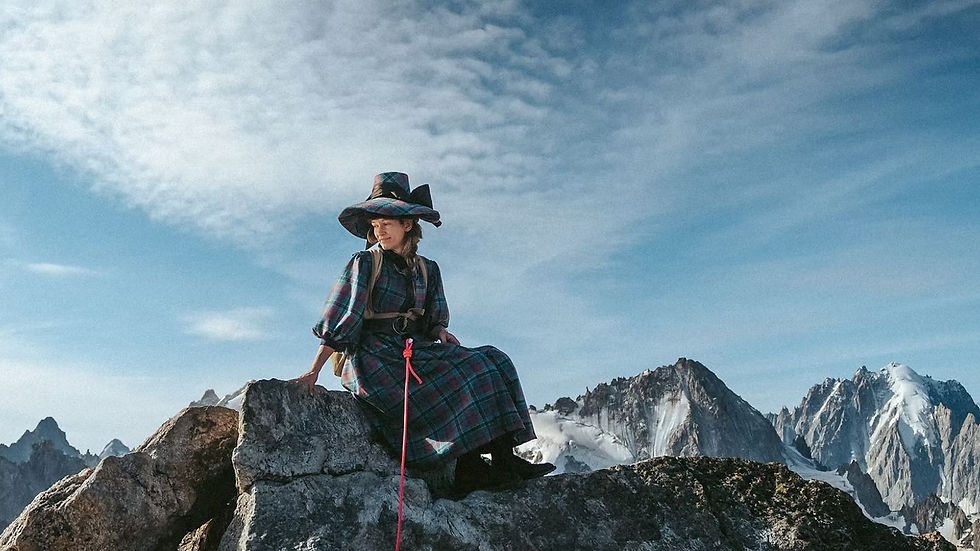
Nearly two centuries later, adventurer and writer Elise Wortley decided the story deserved a proper retelling — in the most literal sense. In summer 2024, with an all-female team, she re-created Henriette's climb using the same equipment and clothing from nearly 200 years ago — including a handmade 10kg wool outfit, created in collaboration with Morley College in London using wool from a regenerative farm.
Because apparently Gore-Tex was considered cheating.
Elise's project, Woman with Altitude, is dedicated to recovering the stories of pioneering women adventurers — and making the case that the outdoors has always belonged to women, whether history remembered it or not. Worth a follow.
Next time you're looking out at that summit from the Aiguille du Midi, remember: two women got there on foot, long before the lifts existed, at a time when the world had decided they shouldn't try.
Marie showed it was possible. Henriette showed it was inevitable. And Elise made sure neither of them was forgotten.
The Mountain Belongs to Everyone Now
It took longer than it should have, but the mountains around Chamonix look rather different today. The first woman to qualify as a High Mountain Guide, Martine Rolland in France did so in 1983 in Chamonix. The pace has picked up steadily ever since, by 2017, six women qualified as High Mountain Guides in a single year. Today, women are guiding ascents of Mont Blanc, leading ski touring expeditions, and navigating the Vallée Blanche with the same quiet authority Henriette d'Angeville brought to her climb nearly two centuries ago. Just with slightly better kit.

Marie and Henriette would, we think, approve.


Comments